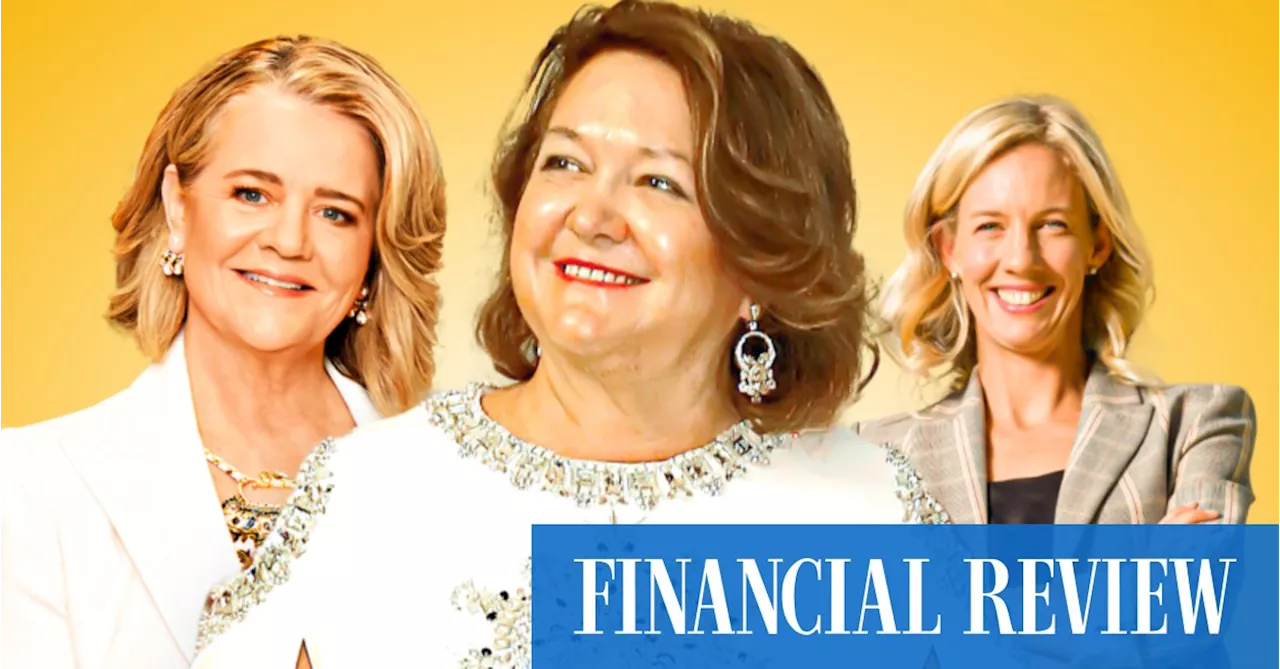
The wealth of Australia’s richest 75 women soared by 30 per cent over the past year, as entrepreneurs in resources, tech, property and fashion enjoyed the fruits of a resurgent market.
The wealth of Australia’s richest 75 women soared by 30 per cent over the past 12 months as female entrepreneurs in resources, technology, property and fashion enjoyed the fruits of a resurgent market.
List, released ahead of International Women’s Day on Friday, has estimated these 75 women to control $151.2 billion, up from $116 billion last year. The Rich Women List is led once again by iron ore magnate Gina Rinehart, with a $37.6 billion fortune. That is up slightly from $36.7 billion a year ago, reflecting a sideways movement for the price of the red metal over the previous 12 months; however, the magnate sees a more structural threat to prosperity. Gina Rinehart is once again the richest woman in Australia, while Nicola Forrest is second and Skip Capital’s Kim Jackson is fourth. “The real problem ... is bad government policies that increasingly make it harder to build new mining projects to create more opportunities, or even to extend current mines,” Ms Rinehart tells the“As I increasingly remind and warn, when mining does well, so do Australians. However, when mining doesn’t do well, nor do Australians.”2023 edition of AFR’s Rich Women List had already bestowed on her that title, in recognition of Ms Forrest’s increasing oversight of the family’s investment vehicle, Tattarang. While the pair have separated, they continue to invest together via Tattarang and her wealth represents half of the former couple’s fortune. The end of romance is also responsible for a new entrant at third on the list: Atlassian co-founder Mike Cannon-Brookes’ wife, Annie Todd. The couple separated last year, leading toWhile a few of their assets were in Todd’s name alone, such as Queensland’s Dunk Island Resort, it seems unlikely any divorce proceedings would not also see her win at least some of her husband’s Atlassian shares, given they constitute the vast bulk of the pair’s fortune. It is understood, however, that she would not receive the voting rights attached to the shares. Kim Jackson, the wife of Atlassian’s other co-founder, Scott Farquhar, also made her debut on the Rich Women list this year. This has nothing to do with separation – the two are very much together by all accounts – but it recognises Ms Jackson’s role as co-founder of Skip Capital, the family office that reinvests the proceeds of Mr Farquhar’s ongoing sales of Atlassian shares. As well as building up a venture capital portfolio, Ms Jackson’s experience as a former investment banker no doubt helpedteams up with private equity fund KKR in a bid for Queensland Airport, according to Street Talk. Canva co-founder Melanie Perkins comes in fifth on this year’s list with a net worth of $6.8 billion – in other words, half of the fortune she has built with husband Cliff Obrecht.a price that has early investors believing new buyers are getting a good deal. Perkins, who has always been uncomfortable with her billionaire status, plans to donate most of her wealth to charitable causes via the Canva Foundation, alongside her husband and co-founder Cliff Obrecht. “We have a two-step plan at Canva. Step one is to build one of the world’s most valuable companies, which we continue making progress towards, and importantly, step two is to use that value to do the most good we can,” she says. “To us, a truly ‘crazy big goal’ is one that feels big and impossible … Uplifting people from extreme poverty is certainly one such goal.“We don’t believe we should be living on this planet where people don’t have their most basic human needs being met – like food, clean water, basic healthcare, shelter and security. It’s beyond atrocious that it’s the case today. We would love to see that change in our lives and will certainly spend our lifetime working towards that goal.” Pop star Kylie Minogue rounds out this year’s Rich Women List, tied in last place with the Baker’s Delight mother-daughter duo Lesley and Elise Gillespie, with a net worth of $130 million. Her wealth increased by $30 million in the last year, thanks to the success of her Grammy-award winning single Padam Padam, and her Las Vegas residency.sale last August of 70 per cent of their eponymous fashion label to US private equity giant Advent International . The deal valued Zimmermann at up to $1.75 billion. The sisters are now worth an estimated $361 million each, catapulting them up 16 places on this year’s list. The biggest fall was suffered by Megan Wynne, founder of employment services group APM, who dropped nine places to 44th. The share price capitulation of APM was the catalyst for Wynne’s fall, with the company suffering from lower earnings due to the low unemployment rate and the expectation of lower fees from an overhaul National Disability Insurance Scheme., it remains down almost 30 per cent on this time last year. A relatively moribund market for public listings, buyouts and venture capital raisings over the past 12 months has not produced many new faces on the Rich Women List this year. Zoe Foster-Blake, who bought back shares in her beauty business Go-To when BWX collapsed for a fraction of their estimated value Crown Point Pastoral co-owner Colleen Costello, one of the largest landowners in the country, alongside her husband Donny CostelloFormer Icon Group owner Cathie Reid, who placed 54th on this year’s list with an estimated net worth of $308 million, is one of the few women on the list who are comfortable talking about wealth – something she hopes will change. “It’s about talking about money in general. I love that there are now groups of women having investor clubs, rather than book clubs. It’s nothing against books, but how much more valuable is it to be sitting around over a glass of wine and talking about your share portfolios,” she says. “Things like that are fantastic ways of getting comfortable talking about money, and that then translates into salary negotiations.”Acknowledging that she was making a broad generalisation, Ms Reid says in her experience of running her cancer care company, men were far more comfortable in saying what they were worth in salary negotiations. She wants this to change. “If you go in apologising for why you believe you’re worth more, that sets the tone for the way the request is heard,” she says. “If you come in more confidently, stating your case about what you’re worth and why, it doesn’t necessarily mean the person will grant you what you want, but you’re heard in a different way.” Thanks to the proliferation of online tools to help people invest in shares, she said it was easier than ever for women to start building investment portfolios. “You don’t need a lot of money to get started.” While a passionate supporter of women in business, Ms Reid took issue with the recent Workplace Gender Equality Agency gender pay gap figures, believing they painted an inaccurate picture of pay discrimination. “Transparency that creates discussion and dialogue is great ... but transparency has to come with accuracy to it,” she says. “It isn’t a situation where there’s a bloke and a woman doing the same job and I’ll pay the bloke 20 per cent more.”Of the 75 females on the Rich Women list, 38 are considered to be self-made, including Trawalla Group’s Carol Schwartz, who ranks 59th with an estimated net worth of $266 million.Schwartz says she was used to being the only woman in the room when she began her career and that, although the business landscape had changed materially, there was still progress on gender equity to be made.“When I was a baby lawyer in the late ’70s, women were being channelled into non-commercial areas of law, either family law or litigation, and you didn’t find many women in commercial law,” she says. “My professional life led me into property ... mainly in shopping centres. I would have been in my early 30s and I would go into meetings and continually be the only woman. “Things have definitely changed, but not enough yet. You still don’t have enough women in very senior roles.” In the next 10 years, Ms Schwartz hopes family dynamics and societal norms will have evolved enough for this to change. “Stereotypes that have been carried forward around who needs flexibility in their work, who contributes more in the home environment, who plays major roles in families, all have to change,” she says.has managed to maintain revenue of more than $100 million, despite the country’s low unemployment rate, which contributed to fellow Rich Lister Megan Wynne’s ASX-listed company APM taking a significant valuation hit.Coupled with her extensive property holdings spanning NSW, Queensland and Victoria, Ms Russo ranked 59th on this year’s Rich Women list, with a net worth of $271 million. She purchased her first property for $40,000 and still owns it today. She believes it is now worth around $1.3 million. Likewise, her first high-rise building, 82 Ann Street, Brisbane, she bought for less than the cost of a single apartment today. “I’ve always loved real estate. My father, when I was a child, used to buy real estate and I used to be a landlord on his behalf because he couldn’t speak English,” she saidMs Russo has only sold a property once, and this sale was something she now regrets. As a child, despite doing her father’s tax returns from the age of 10, she was told she would fail Year 12. Self-belief, she said, has been her greatest driver.Valuations for the list were ruled off at the beginning of March and are based on the Rich List team’s best assumptions from publicly available information. Michael Bailey writes on entrepreneurship and the arts. He is also responsible for the Financial Review's Rich Lists. He is based in Sydney.
