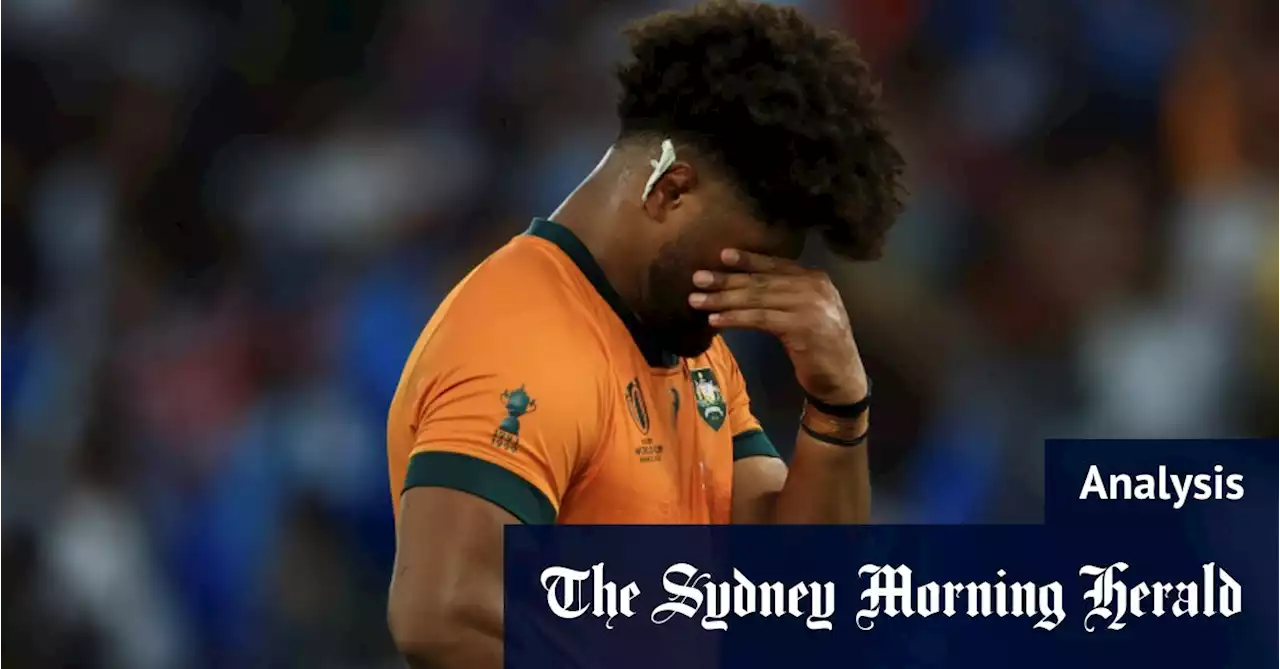
‘Wicked problem’: From the ruins, can Australian rugby be rebuilt?

Australia News News

‘Wicked problem’: From the ruins, can Australian rugby be rebuilt?
Australia Latest News,Australia Headlines

Experts say Australia’s disastrous World Cup campaign is the result of long-term decline. So, what are the problems and can they be fixed?

to finally get a nationally aligned high-performance model off the ground. The ailing financial health of some states left them no choice, and Rugby Australia chair Hamish McLennan said this week he hoped any reluctance to get on board would fade given the disastrous World Cup results.

“I would hope it actually makes it easier because you don’t need any more proof for why we need to change,” McLennan said.“The evidence for structural change has been building for years and years and, whilst the recriminations will always be there, the blueprint for reform and necessary change has been talked about by us for many years now. We need to seize the opportunity to fix the game for good.”But old habits die hard, and the mistrust about head office and the ability of its powerbrokers lingers in some member unions. The timing of Rugby Australia chasing more NRL talent this week, at a time when the game’s lower levels are crying out for grassroots funding, was seen as tin-eared. And while the Wallabies’ results are a symptom of longer-term illness, the chaos of the RA-endorsed Jones’ regime has many baffled. A stat flew around this week: of 37 nationally contracted players, only 17 are at the World Cup.“From here, it now has to be a moment where we come together, which is the hardest thing in rugby,” Turinui said on Stan Sport. “Because right now, states, different factions, former players, are looking sometimes at, ‘How can I go for a land grab’. But I think we need to go past all of that and find a way. So [the loss to Wales], as hard as it was, is not wasted as a moment to be humbled, to have actual self-reflection in the game, and to plan a way forward.” Stephenson said there is a possibility some states might resist change, “but I would be disappointed if all five did”. “The challenge is no one has quite got the plan. If people see some direction and see a plan [for centralisation], they will say, ‘Let’s get in behind it and let’s go’. There is a little bit of, ‘Show us what it is and how it will work’,” he said. “There is a leap of faith involved. But from my perspective and the Rebels’ perspective, we know the code has to be stronger. It has to be all hands in the middle now.”The data tells a compelling story that Australia’s success in Super Rugby – and at Test level – has gone steadily downhill since a fourth club and then fifth were added. Not only does Australia not have the playing depth to populate five successful teams, the spread hurts all five and prevents the chance to build “cohesion” – the benefit gained from players being together for years as juniors in the same sides. Ireland have only four professional teams and Scotland have only two.The Force and Rebels have never made the finals, and notable New Zealand figures like Sir Steve Hansen have repeatedly argued Australia needs to cut two Super Rugby teams. Jones also used to say as much. “None of them make any money, and only one has private money. So, it’s not producing high performance for us, and it is not financially sound, why aren’t we considering change?” asks former Wallabies forward and premiership-winning Randwick coach Steve Hoiles. “People get really shitty when you talk about this, but is five teams helping us produce a better Wallabies program? The answer is no. And is five teams helping us produce a better spectacle and a financial model that is funding the grassroots? It’s not. “You make it harder for players to get contracts, and do the tough years in club footy. And then get a really competitive environment to even get into Super Rugby. So then you are surrounded by successful players and teams, and the individual performances improve. And then you have more cohesion, too. The average win percentage of many of the Wallabies, in all their footy, would be 40 per cent. How do we expect a team full of players winning four out of 10 games to compete at a World Cup?”, citing financial reasons, but given the animosity and angst involved, administrators are loath to go through it again. The Force stayed alive and returned to Super Rugby during COVID.Stephenson says it’s a redundant argument anyway, and points out Victoria’s success in becoming a genuine talent pipeline, with 19 homegrown players pulling on gold jerseys this year, in the Wallabies, Wallaroos and Junior Wallaroos. There was the record crowd of 84,000 at the MCG in July, academy systems in eight public schools, a centre of excellence, and consistent government major events funding. “It is easy to look back at yesteryear and say when we had three teams, we did this. But the world has changed and moved on. It is a simplistic view,” he said.Australia has committed to play in Super Rugby with five teams, in any case. So for many, the key piece of the puzzle is building systems and competitions to help Australia become more competitive. Most Australian rugby players play only 16-20 professional games a year, from January to June, whereas Kiwis and Irish players have a 30-game season. Super clubs are filling their own gaps, touring Japan and South Africa in the off-season. A third tier has been run twice, and though expensive, it has demonstrable developmental benefits for players and coaches. Conversations about building a national club competition are being had, and some are advocating for a 25-game state-based competition to run alongside the Wallabies from July to September. Rugby Australia is about to appoint a high-performance director, and says all those elements will be part of a new aligned structure. But Fujak says governance reform is only one piece of the puzzle, and what may actually be most effective is cultural change in rugby’s leadership ranks and a move away from the “old boys” networks that have populated the top jobs at Rugby Australia for too long.Fujak comes back to the powerful positivity loop that feeds public sentiment about AFL and NRL. There are always winners to be celebrated and discussed on a Monday morning. Those good vibes have been in short supply in Australian rugby for years. That void could yet bring more pain, with the current generation of kids not falling in love with the game or its stars – even in rugby heartland markets.“Of the few tangible solutions, for me I would bite the bullet and break off from New Zealand in Super Rugby. If you have an eight-team domestic competition, it means you are going to have four Australian teams winning every week, and an Australian team wins the grand final,” Fujak said. “The quality might be lower than being in a combined competition but I think that is now very secondary to having more franchises embedded in Australia, having them win against each other. “And even if you let the top-tier Wallabies go to Europe and Japan and you just had a salary cap of $3 million in this eight-team competition, I think the absolute quality would be relatively secondary to having those clubs in the community, having teams win every week, the tribalism, having an Australian champion every week.Watch all the action from on the Home of Rugby, Stan Sport. Every match streaming ad-free, live and in 4K UHD with replays, mini matches and highlights available on demand.

We have summarized this news so that you can read it quickly. If you are interested in the news, you can read the full text here. Read more:

smh /  🏆 6. in AU


Australia Latest News, Australia Headlines

Similar News:You can also read news stories similar to this one that we have collected from other news sources.
One in six species at risk of extinction in Great Britain, say wildlife expertsOne in six species at risk of extinction in Great Britain, say wildlife expertsState of Nature report paints bleak picture of wildlife in UK but says conservation methods are yielding results
Read more »

The people who have led Australian rugby into crisis must be held to accountThe people who have led Australian rugby into crisis must be held to accountEddie Jones isn’t solely to blame for what happened to the Wallabies. The rugby system in this country is at fault – starting at the top.
Read more »

The people who have led Australian rugby into crisis must be held to accountThe people who have led Australian rugby into crisis must be held to accountEddie Jones isn’t solely to blame for what happened to the Wallabies. The rugby system in this country is at fault – starting at the top.
Read more »

The people who have led Australian rugby into crisis must be held to accountThe people who have led Australian rugby into crisis must be held to accountEddie Jones isn’t solely to blame for what happened to the Wallabies. The rugby system in this country is at fault – starting at the top.
Read more »

The future of Australian rugby is in Queensland’s handsThe future of Australian rugby is in Queensland’s handsThere is a solution to Australian rugby’s crisis that everyone can see, so why have years gone by without anyone doing it? It’s time for Ballymore to get on board.
Read more »


Render Time: 2026-05-14 19:00:47